
The Return of Thermal Mass for your Comfort and Wellbeing
Reduce your HVAC Dependance!

Something profound is happening in residential design—a quiet revolution that looks backward to move forward. After decades of building homes as lightweight, mechanically-dependent boxes, architects are rediscovering what ancient builders always knew: that dense, heavy materials don't just hold up buildings—they hold temperature itself, creating spaces that breathe with the rhythms of day and night rather than fighting against them.
This is the return of thermal mass. Not as nostalgic pastiche, but as sophisticated, evidence-based design that acknowledges a simple truth: we don't actually heat and cool most buildings today—we heat and cool the air inside them, burning through energy and money while remaining utterly dependent on mechanical systems that represent over a third of construction costs and consume nearly forty percent of U.S. national energy.
The Physics of Instinctive Comfort
Thermal mass refers to the capacity of building elements to store sensible heat by virtue of their heat capacity and conductance, commonly achieved with high-density materials such as concrete, masonry, or rammed earth. The mechanism is elegant: thermal mass acts like a heating or cooling battery that charges and discharges very evenly and gradually, naturally, with no moving parts and nothing to maintain.
But the real magic happens in how this transforms lived experience. High mass buildings have smaller interior air temperature variations than low mass buildings, yielding energy savings in HVAC operation. This isn't just about metrics—it's about creating environments where temperature stability feels instinctive, where your body doesn't have to constantly adjust to mechanical temperature swings, where comfort becomes a quality of the architecture itself rather than a function constantly negotiated by machines.


The Energy Proposition
The numbers are compelling for any market segment, but particularly for spec builders and developers watching construction costs and energy mandates tighten simultaneously. Experimental research in energy-efficient single-family buildings showed that replacing lightweight frame structures with cellular concrete reduced cooling energy demand by 67% at 25°C set point temperature and 75% at 26°C set point temperature.
Compared to traditional lightweight constructions, brick houses with higher thermal mass can reduce energy consumption for heating and cooling by about 40%. In extreme heat conditions, the performance becomes even more dramatic: during the August 2015 heatwave, increasing thermal mass shortened the total time of indoor temperatures exceeding 28°C from 18.6 days to only 8 hours.
These aren't marginal improvements—they're transformative reductions that compound over building lifetimes. A well-designed building with appropriate thermal mass may use 30-50% less energy than traditional constructions, directly translating to reduced operating costs, smaller HVAC equipment requirements, and enhanced marketability in an increasingly energy-conscious luxury market.

Stone: The Original Temperature Bank
The project utilizes thermal mass to create a comfortable and energy-efficient living environment, with substantial stone walls that absorb heat during the day and release it slowly at night, serving as both thermal mass and structural backbone. Stone offers something concrete rarely can: a direct connection to place, geological time made tactile.
From the granite outcroppings of the American Southwest to the limestone terraces of the Mediterranean, stone speaks in the vernacular of its landscape. Natural stone combines beauty with efficiency, efficiently absorbing and retaining heat, making it ideal for visually striking and energy-efficient spaces. The aesthetic isn't decorative—it's foundational. When you touch a stone wall at dusk and feel the day's warmth radiating back, you're experiencing architecture as climate mediator, the building itself participating in the daily thermal cycle.
Contemporary stone thermal mass applications range from traditional load-bearing walls to feature elements—a massive stone fireplace surround, an interior partition wall, travertine flooring that drinks in southern sunlight. Each becomes both sculpture and system, beauty and performance unified.
Concrete: The Modern Vernacular
If stone connects us to geological time, concrete connects us to human ingenuity—the alchemical transformation of earth, water, and chemistry into stone-like permanence. Concrete possesses exceptional heat retention capabilities, allowing it to serve as an effective thermal storage unit that regulates indoor temperatures and reduces energy consumption.
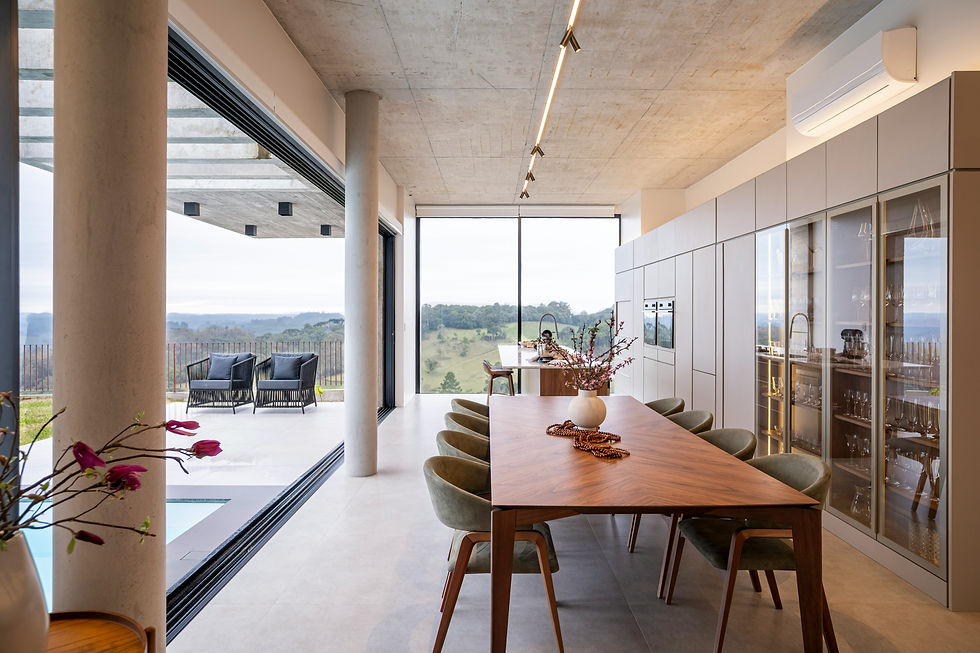
The aesthetic evolution of concrete in residential design has been remarkable. What was once hidden beneath finishes is now celebrated: board-formed walls revealing wood grain shadows, polished floors reflecting light throughout the day, exposed ceilings providing both thermal regulation and loft-like volume. By insulating the concrete structure's exterior and exposing original concrete surfaces to indoor air, studies show interventions can result in overall energy demand savings of 50% to 75%.
The luxury market increasingly appreciates concrete's honest materiality—its weight, its thermal stability, its resistance to trends. There's integrity in a material that performs as beautifully as it presents, that ages into character rather than obsolescence.
Rammed Earth: Ancient Technique, Contemporary Expression
Perhaps no material embodies the thermal mass renaissance more completely than rammed earth. One significant benefit of rammed earth is its high thermal mass—like brick or concrete, it absorbs heat during the day and releases heat at night, moderating daily temperature variations and reducing the need for air conditioning and heating.
Rammed earth is made up of compressed layers of raw materials, including sand, gravel, clay, and a stabilizer, with warm colors and textures that typically harmonize with a building's natural surroundings in an aesthetically appealing manner. The construction process creates walls that are striated with a mix of earthy tones and textures that add character to a structure—every wall becomes a unique geological section, recording its making in visible layers.
Rammed earth structures possess a distinct beauty that stems from natural variations in color and texture, with warm, earthy tones evoking a sense of harmony with surroundings. This isn't faux finish—it's authentic material expression. And the performance matches the aesthetics: warmth requires almost 12 hours to be conducted through a wall 35 cm thick, and the density, thickness, and thermal conductivity render it especially suitable for passive solar heating.
For custom residential and boutique hospitality projects, rammed earth offers something increasingly valuable: uniqueness embedded in performance. When properly designed and constructed, rammed earth walls can last for centuries, with historical examples such as the Great Wall of China and various ancient fortifications standing as testaments to exceptional longevity.
Designing with Thermal Mass: The Integration Imperative
Effective use of thermal mass for indoor comfort requires attention to three interrelated design variables: material properties, geometric configuration, and operational regime. This isn't plug-and-play—it demands sophisticated integration from earliest design phases.
Material Strategy: High volumetric heat capacity and moderate conductivity favor storage without excessively rapid surface temperature swings, with cementitious materials widely used because of favorable density and durability. The choice between stone, concrete, rammed earth, or hybrid systems should consider not just thermal performance but embodied energy, local availability, and aesthetic intention.
Passive Solar Synergy: Interior spaces and their thermal masses—such as concrete walls and floors—should be oriented to capture as much sunlight as possible, with south-facing windows carefully sized and placed so that low winter sunlight shines directly on the thermal mass, which collects and stores that heat during the day and releases it at night.
Climate Calibration: Thermal mass design is best suited for buildings in constant or regular use, requiring temperature variation between night and day to be at least 5°C for thermal mass to work efficiently. This makes thermal mass particularly effective in climates with significant diurnal temperature swings—desert regions, Mediterranean climates, and temperate zones with distinct seasons.
Ventilation Integration: Recent modeling emphasizes the importance of coupling internal thermal mass with appropriate ventilation strategies—naturally driven buoyancy ventilation can actively charge and discharge internal mass without mechanical cooling. Night flushing becomes choreographed performance: opening windows after sunset allows thermal mass to release accumulated heat, pre-cooling the building for the following day.

The Aesthetic of Honesty
There's a reason thermal mass materials resonate so powerfully in contemporary wellness design: they embody architectural honesty. These are materials that look like what they are, that perform as they present, that age with grace rather than degradation. Rammed earth walls are breathable and naturally regulate humidity levels, creating a comfortable and healthy indoor environment while reducing the risk of mold growth and improving air quality.
The visual language of thermal mass—the striation of rammed earth, the formwork impressions in concrete, the geological variations in stone—tells stories of making, of material transformation, of human craft intersecting with elemental forces. In luxury residential design, where authenticity increasingly trumps artifice, these materials offer something Instagram filters can never replicate: genuine material presence.
The color palettes are inherently sophisticated—the warm ochres and siennas of rammed earth, the cool grays of concrete, the infinite variations of natural stone. These aren't colors applied to surfaces; they're colors emerging from material composition, shifting with light quality throughout the day, deepening with moisture, developing patina with age.
The Business Case for Thermal Mass
For developers, builders, and design professionals, thermal mass represents a convergence of performance, marketability, and long-term value:
Reduced Operating Costs: In Memphis, buildings with appropriate thermal mass could save at least 14 percent on energy costs, and in Salem at least 21 percent
Downsized Mechanical Systems: Smaller peak loads mean HVAC systems can be downsized and expensive energy-demand charges can be minimized
Wellness Differentiation: Thermal stability and humidity regulation directly support WELL Building Standard criteria
Aesthetic Premium: Authentic material expression commands higher values in luxury markets
Durability: Rammed earth is generally very durable—the basic technology has been around for thousands of years with many buildings still standing that are centuries old
Climate Considerations
High thermal mass is beneficial in climates where there is reasonable difference between day and night temperatures, while in hot humid climates, low-mass constructions are preferred unless the home includes air-conditioning. This specificity matters—thermal mass isn't universally appropriate, and sophisticated design recognizes when to employ it and when alternative strategies better serve comfort and efficiency.
In mixed climates requiring both heating and cooling, high thermal mass can help to passively heat and cool homes at low cost when combined with other passive design principles like orientation, insulation, and appropriate glazing. The key is integration, not isolation—treating thermal mass as one element within a comprehensive passive design strategy.
Looking Forward by Looking Back
The use of thermally massive materials in buildings dates back thousands of years, with ancient civilizations such as the Egyptians and Romans constructing buildings with thick, heavy walls made of materials such as stone or adobe. We're not inventing thermal mass—we're rediscovering and refining principles that created buildings still standing after millennia.
But this isn't nostalgia. It's the synthesis of ancient wisdom with contemporary building science, traditional materials with modern engineering, intuitive comfort with quantified performance. It's recognizing that the most innovative path forward sometimes means recovering knowledge we'd abandoned in our rush toward mechanical complexity.
The return of thermal mass represents architecture coming home to first principles: that buildings should moderate climate, that materials should do what they do best, that comfort should feel instinctive rather than mechanically maintained. In an era of rising energy costs, climate anxiety, and hunger for authentic material experience, thermal mass offers something increasingly rare—a design strategy that makes buildings simultaneously more comfortable, more efficient, more beautiful, and more honest.
The question isn't whether thermal mass belongs in contemporary residential design. The question is: why did we ever build without it?
Resources & Further Reading
Contemporary Design Applications:
Technical Research & Performance Data:
Design Guidance & Implementation:
Rammed Earth Specific:
HVAC Integration & Optimization:


Comments